
Social Anxiety in Dogs
Social anxiety is a troubling disorder for both dogs and their owners. Some dogs experience nervousness or fear in situations that involve other dogs
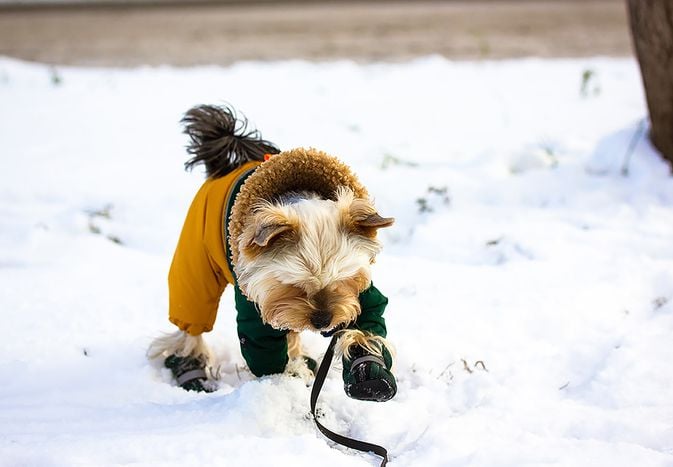
When the seasons reach their most extreme, it can be dangerous for dogs to venture outside barefoot. That's why it's a good idea to train your pup how to wear dog boots.
Both extra-cold and super-hot pavement can cause serious issues for your dogs' paws. The cold weather can lead to frostbite, and salt and chemicals left on the winter ground can irritate your dog's pads. In the summer, a hot sidewalk or driveway can burn your dog's pads and force a trip to the vet.
So how about we prevent all that and try on some dog boots?
According to Benjamin Bennink, board chair of The Association of Professional Dog Trainers, this is more about getting your dogs used to being near the boots and, eventually, wearing them. Each kind of dog boots will come with instructions for actually putting them on properly—just make sure you have the right size before you buy.
You might be able to skip some steps if you've handled your dog's feet before—kudos if you're a champion nail clipper—but Bennink starts with the basics. Remember, you should start this training early, before it's too cold or too hot. You can even do it as soon as your puppy comes home, Bennink says. This kind of socialization is more important than "sit" and "stay" at this point.
Be sure you move at a pace your dog is comfortable with, Bennink says. Maybe try one step per day or one step for every two days.
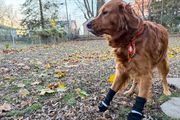
Begin by getting your dogs used to having their feet handled. Bennink says you can do this by touching their feet briefly, for only a few seconds, before rewarding them with a treat. Classic positive reinforcement.
Then progress to holding your dog's feet for a more extended time. Reward the pups with a treat again. Then hold a foot and a boot near each other, introducing the footwear to your dog. (And reward with a treat again, too.)
If your dog seems ready, try putting the boot on the pup's foot for a moment or two and reward them with another treat.
Assuming all of the above goes well, it's time for a test run. Have your dogs wear the boots around indoors for five to 10 minutes at a time, Bennink says. Keep rewarding them with treats, and repeat these sessions until your dog seems comfortable.
Keep in mind that it might take a while for your dog to get comfortable. We've all seen the videos of dogs crazy-walking in boots because they're unfamiliar, but it's not their fault. It's weird for them to still feel something under their feet when they pick up their feet.
"It takes them a little while to get used to it," Bennink says.
Training your dog to wear boots could take a long time, or it simply won't work at all. If you're trying to train an adult dog who doesn't like his feet being handled, this could prove to be an immense challenge.
If your dog is objecting to the boots, don't force it. At no point should you be in a wrestling match with your dog to get his boots on. That's when it's a good idea to hire a dog trainer who can deploy a more specialized strategy.
At that point, you should ask yourself another question: Does your dog really need the boots? Bennink says you need to consider whether the benefits outweigh the alternatives.
If you live in a city where the temperatures can get too hot or cold (or both), then you probably need to persevere with dog boots training, he says. But if your dog lives in an area with plenty of grass and shade to walk in—away from the scalding or freezing pavement—maybe the boots aren't needed.
As always, you can always ask your veterinarian or a local trainer whether you need them, and then they can offer additional guidance.
Social anxiety is a troubling disorder for both dogs and their owners. Some dogs experience nervousness or fear in situations that involve other dogs

Pit bulls have unfortunately been stereotyped as aggressive and dangerous animals, but a well-socialized and trained pit bull is far from it. Modern p

If the seeds are plain and unshelled, dogs can have pistachios as a small snack, but the risks of illness and choking hazard should have you looking e

Seizures are one of the most common neurological problems in dogs. They occur when the cerebral cortex of the brain functions abnormally, but there ar

Heat exhaustion is a term used for moderate overheating, and it is very important to be aware of the signs to know when to seek help and to prevent mo

Small hypoallergenic dogs are perfect for people who love little dogs but don’t love fur all over the house. Hypoallergenic dog breeds are also ideal

The American cocker spaniel is a small sporting dog breed from the United States that has a long, silky coat; big, expressive eyes; and long, furry ea
The English Labrador retriever is a medium-large sporting dog breed from the United Kingdom with a short, dense, water-repellent double coat in black,
We are a comprehensive and trusted information platform dedicated to delivering high-quality content across a wide range of topics, including society, technology, business, health, culture, and entertainment.
From breaking news to in-depth reports, we adhere to the principles of accuracy and diverse perspectives, helping readers find clarity and reliability in today’s fast-paced information landscape.
Our goal is to be a dependable source of knowledge for every reader—making information not only accessible but truly trustworthy. Looking ahead, we will continue to enhance our content and services, connecting the world and delivering value.