
How to Stop Aggression in Dogs
If your dog regularly growls, snaps, or bites, you might have a behavioral problem of aggression on your hands. Aggression is one of the top reasons d

The Rottweiler, or Rottie, is a large and rugged dog with a hard-working and confident demeanor. It is known for its muscular body, thick hindquarters, and easy trot. Descended from the mastiffs of the Roman legions, the Rottie can be a gentle playmate and companion, despite its reputation for being dangerous. The breed is a bit aloof but also very intelligent, protective, and loyal to its family. The Rottie can be an excellent working dog, watchdog, or guard dog, too.
GROUP: Working
HEIGHT: 22 to 27 inches at the shoulder
WEIGHT: 80 to 130 pounds
COAT: Short double coat
COAT COLOR: Black with tan, rust, or mahogany
LIFE SPAN: 8 to 10 years
TEMPERAMENT: Steady, alert, self-assured, fearless, devoted, confident, good-natured, obedient
HYPOALLERGENIC: No
ORIGIN: Germany
The Rottweiler is intensely loyal and protective of trusted family members. This breed also has a playful and affectionate side that it reveals when at ease. Few Rotties have an aggressive nature, despite what some people think. They are usually very calm, loyal, and loving companions to those they trust. However, they may be suspicious of strangers due to their protective nature.
| Affection Level | High |
| Friendliness | High |
| Kid-Friendly | High |
| Pet-Friendly | Low |
| Exercise Needs | High |
| Playfulness | High |
| Energy Level | Medium |
| Trainability | High |
| Intelligence | High |
| Tendency to Bark | High |
| Amount of Shedding | Medium |
Though the exact origins of the Rottweiler are not known, it is believed that the breed derived from the mastiff and that its ancestors can be traced back to ancient Rome. They were drover dogs who herded livestock for the army. Later development of the breed occurred in the German town of Rottweil, where it worked as a cattle dog and sometimes a police dog before its popularity diminished. At one time, the breed was referred to as the Rottweiler metzgerhund, which roughly means butcher's dog of Rottweil.
In the early 20th century, the breed was once again used as a police dog and began gaining popularity in the U.S. The hard-working nature of the Rottweiler has made its popularity grow over the years and it is now the eighth most popular breed, according to the American Kennel Club (AKC). The breed was recognized by the AKC in 1931.
Rotties can be excellent companions for all kinds of families, including those with children (provided you train your dog to behave around kids and also teach your kids how to safely interact with dogs). The Rottweiler has a drive to work, high endurance, a commanding presence, and potential for territorial behavior. Many Rotties will benefit from some type of "job," such as guarding the home, obedience competition, or tracking.
Ideally, a Rottie should get vigorous exercise including walks and playtime for at least two hours a day. A Rottweiler loves to have fun with its human companion so engage in games of hide-and-seek, fetching, and tugging. Just beware that since this breed may be aggressive towards new dogs, your Rottweiler may not be welcome at the dog park.
The Rottie's short, somewhat coarse, but shiny hair coat has a moderate shedding rate and requires little more than basic grooming care. Use a curry brush or similar tool to brush your Rottie periodically and keep the coat healthy. Expect heavier shedding in the spring and fall.
Some Rotties will naturally wear down their nails, but it is important that you inspect them regularly and trim the nails as needed. This will keep your dog's feet healthy and comfortable.
Good oral hygiene will benefit your pet. Brush your dog's teeth daily or at least two to three times per week.
It is essential that all Rotties be put on a strict training program to best utilize their intelligence and energy, keeping them happy, healthy, and safe. In addition, proper socialization is imperative and will help your Rottie feel comfortable in many situations. Playing rough with a Rottie could encourage any aggressive tendencies.

Responsible dog breeders work hard to maintain the highest breed standards as established by kennel clubs like the AKC. Dogs bred by these standards are less likely to inherit health problems. However, there are some hereditary health issues that may occur in the breed. The following are some conditions to be aware of:
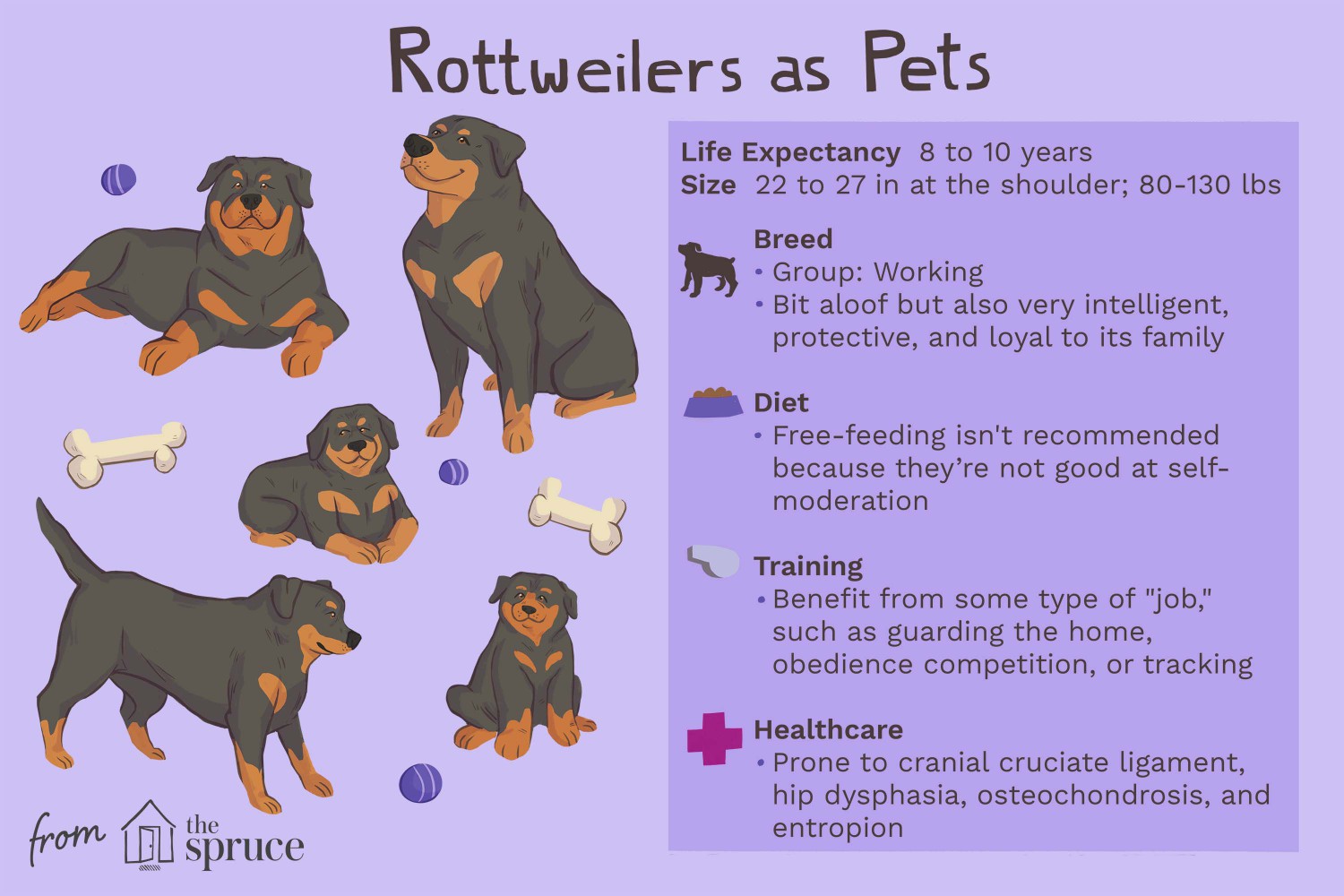
Illustration: The Spruce / Emilie Dunphy
Feed a Rottweiler two meals of 2 to 5 cups of dry food per day. The amount depends on the dog's size, activity level, age, and other factors. Free-feeding isn't recommended because Rottweilers are not good at self-moderation and will tend to put on weight if allowed to eat whenever they want. Obesity will shorten your dog's lifespan, so discuss this with your veterinarian to get a recommended feeding schedule, amount, type of food, and exercise plan.
If you think you are ready to have a Rottweiler, it's important to do more research first. Get opinions from veterinarians and pet professionals, and ask Rottie owners, responsible breeders, and rescue groups for more information.
No matter the breed, if you adopt a dog, discuss temperament testing (rescue groups and shelters usually do this before putting pets up for adoption). If you are buying from a breeder, ask about the line's temperament history and meet the puppy's mother (and father if possible). Behavior traits can be inherited, but good breeders breed for good temperament. Sadly, some irresponsible breeders will purposely breed dogs for aggression.
The American Rottweiler Club is a great place to start your search for a Rottie. The club's breeder referral coordinator can connect you with a member breeder.
The Rottweiler Rescue Foundation supports rescue groups throughout the U.S. and lists their contact information so you can research adoptable dogs by region. Remember to check the laws of your jurisdiction if you want to adopt a Rottweiler.
You can pay several hundred dollars to adopt or rescue a Rottweiler, but expect to pay a breeder between $850 to $3,500 or even more for a Rottie puppy depending on bloodlines and certain other characteristics.
Intelligent
Loyal and protective
Courageous and athletic
Tendency to herd children may interfere with family harmony
Commanding presence that may intimidate people or other animals
Strong prey drive may make them incompatible with other pets in the house
If you’re interested in similar breeds, look into these to compare the pros and cons:
Explore the range of dog breeds out there. With a little research, you can find the right one to bring home.
This breed has a tendency to herd children, giving them a nudge, which might knock over a small child. A Rottweiler may also be overly defensive of the kids in its family and intervene when they are rough-housing with other kids. The dog's prey drive may kick in and lead it to chase running children.
Rottweilers may not be a good choice for multi-pet households. Their prey drive may make them aggressive with cats and other small pets and they also may be intolerant of dogs of the same sex in their households.
Unfortunately, the Rottie has a reputation as a dangerous breed and may be subject to breed-specific legislation. You must check the laws of your jurisdiction if you want to adopt a Rottweiler. You will also need to check local laws when you travel with your pet. Your home or renters insurance carrier may require extra liability coverage if you own a Rottweiler. However, this is an unfair generalization: Any dog can be aggressive, regardless of breed. The key is training and socialization.
In addition to breed-specific legislation issues, many experts add that this is not an ideal breed for apartment living as this dog does best with a yard to play in. However, you may see in some literature that this breed is considered a good apartment dog because it is gentle.
If your dog regularly growls, snaps, or bites, you might have a behavioral problem of aggression on your hands. Aggression is one of the top reasons d

Welcoming a new baby into the family is exciting. It can also be stressful, especially if you already have a dog. Hopefully, you've spent the last

What does it mean when a dog has pale gums? And is there anything you should do about it? Pale gums in dogs are a sign of one or more underlying probl

Lymph nodes are found in various places in the body. These small glands are not typically easy to find or feel unless they become enlarged. Swollen ly

The harrier is a medium-size hound dog breed from the United Kingdom with a short, smooth coat and strong resemblance to beagles and foxhounds. The br

A popular service breed, the German Shepherd is a large and athletic dog that's known to be highly intelligent, loyal, and agile. They are hard-workin

The Nederlandse Kooikerhondje (also known as the Kooiker) is a petite spaniel with Dutch roots and a distinctive white and orange (or red) coat. The c
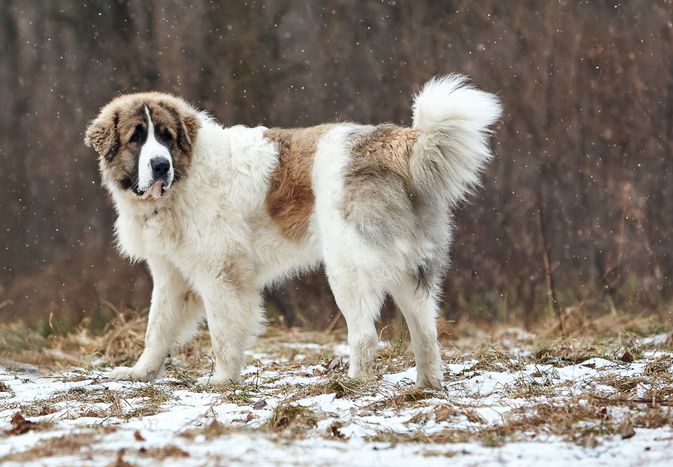
The Pyrenean Mastiff, also known as the Mastín del Pirineo, is a large, fluffy-haired breed originally from the Pyrenees mountains in northeastern Spa
We are a comprehensive and trusted information platform dedicated to delivering high-quality content across a wide range of topics, including society, technology, business, health, culture, and entertainment.
From breaking news to in-depth reports, we adhere to the principles of accuracy and diverse perspectives, helping readers find clarity and reliability in today’s fast-paced information landscape.
Our goal is to be a dependable source of knowledge for every reader—making information not only accessible but truly trustworthy. Looking ahead, we will continue to enhance our content and services, connecting the world and delivering value.