
Do Older Dogs Get Menopause?
Female dogs and female humans may have some things in common but when it comes to menstrual cycles there are differences. Knowing what to expect with

You have probably seen a dog bare its teeth at one point or another. You might have thought it meant "stay away" and you were probably right. But what does it really mean when a dog bares its teeth? Do some dogs smile? If your own dog shows his teeth, is it aggression or is he smiling?
When a dog bares his teeth he is using body language to communicate. It's important to have some understanding of dog body language so you can understand what your dog is trying to tell you.
In dogs, the term "bared teeth" simply means a dog is showing teeth. A dog bares his teeth by curling his lips back to reveal his teeth. It is a reflexive action that occurs in reaction to certain situations. Bared teeth in a dog are often a warning.
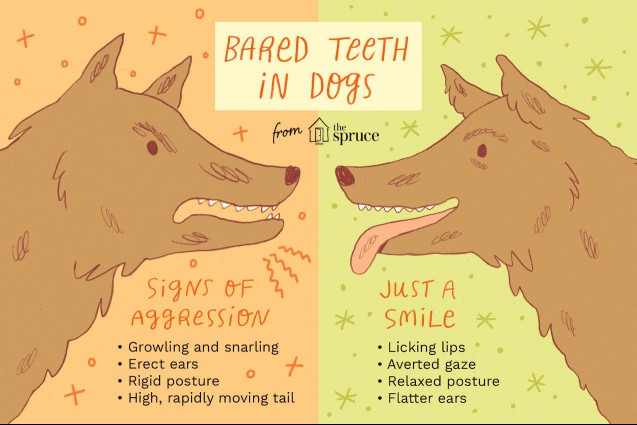
In most cases, when a dog bares his teeth he is sending you a clear message to back off. Think of bared teeth as a warning: "I am going to use these teeth if you don't stop it." This behavior may be a precursor to more serious aggression. This type of dog body language is often accompanied by vocalizations, such as growling and snarling. You may also notice body language that indicates a dog is becoming aggressive, such as erect ears, a rigid body posture, and a tail that is held high and moving back and forth rapidly. If your dog's warning is ignored, the behavior could progress to snapping or biting.
Dogs display aggression for a number of reasons, such as fear, feeling overwhelmed, pain or anticipated pain, overstimulation, resource guarding, and territoriality. No matter the reason a dog becomes aggressive, bared teeth are usually a sign he is being pushed past his comfort zone. If you see a dog with this type of body language, it's best to leave this dog alone. Avoid eye contact and carefully step away from the dog.
Occasionally, a dog bares his teeth without any aggressive tendencies behind it. This is referred to as a submissive grin or a smile. It is usually accompanied by non-threatening body language such as lip licking, an averted gaze, a relaxed body posture, and ears sitting flatter against the head. The submissive grin is a type of appeasement gesture intended to calm down a situation. For some pets, the submissive grin can indicate stress and anxiety so it is important to always pay close attention no matter how long your pet has been doing it.
Many veterinarians associate averted gaze and lip-licking behaviors with stress and anxiety. If you notice averted gaze or lip licking in your dog during a presumed submissive grin, attempt to remove the stimulus that causes it as we always want to avoid encouraging stress or anxiety in our pets.
In general, submissive grins are not very common but for a few pets can be normal. However, if your dog is grinning because he is stressed or afraid, he could eventually feel threatened enough to get defensively aggressive.
The Spruce Pets/ Ashley Nicole DeLeon
If your dog is baring his teeth at you or someone else, take a look at his other body language. If you are uncertain of the cause or it appears that the teeth are bared in an aggressive manner, you should carefully remove yourself and/or your dog from the situation. Then seek the help of dog professionals, which may include a combination of a dog trainer, behaviorist, and veterinarian to rule out a pain-related/medical issue. You must act quickly before your dog bites someone.
If you are unsure whether your dog is exhibiting a submissive smile or becoming aggressive when he bares his teeth, your best bet is to call in the help of a professional dog trainer or behaviorist. These experts are specially trained to detect the most subtle clues in your dog's body language and behavior. It's always a good idea to put safety first.
If you feel absolutely certain that your dog is simply smiling and his body language otherwise appears submissive, you probably don't need to be alarmed. However, it is important that you keep watching your dog to determine if he becomes uncomfortable or nervous in his current situation. You should also keep observing to make sure you are not misreading the signs.
In dogs that truly do smile, many owners are able to train their dogs to smile on cue. This is best taught by capturing the behavior and rewarding it while attaching a cue word like "smile." Just be absolutely certain that the dog is definitely smiling—and not showing aggression—before you teach your dog to do it on cue! Also, make sure you are not inadvertently reinforcing signs of fear or anxiety in your dog since some dogs will display this grin when they are nervous.

Female dogs and female humans may have some things in common but when it comes to menstrual cycles there are differences. Knowing what to expect with

Is your dog pregnant? It's important that you give her the special care she needs during her pregnancy. There are several ways you can prepare fo

Seizures occur when electrical signals become uncontrolled in the brain. They may occur in dogs with certain diseases, tumors, toxicities, or too high

It's very common for puppies and young dogs to get car sick from the motion, stress, and excitement. They may appear lethargic, whine, drool, cry,

Ascites in dogs is an abnormal buildup of abdominal fluid that occurs as a result of an underlying disease. Several health conditions can cause ascite
Popularized by dog lovers and families that need a low-shedding dog, doodle dog breeds of many kinds can be found in homes around the world. These flu

The Bouvier des Flandres is a large herding breed from Belgium with a sturdy body to pair with its wiry fur, floppy ears, bearded face, and fluffy app

Seizure-alert dogs are service animals trained to warn their owner about the onset of a seizure. While it’s not entirely known how dogs are able to pr
We are a comprehensive and trusted information platform dedicated to delivering high-quality content across a wide range of topics, including society, technology, business, health, culture, and entertainment.
From breaking news to in-depth reports, we adhere to the principles of accuracy and diverse perspectives, helping readers find clarity and reliability in today’s fast-paced information landscape.
Our goal is to be a dependable source of knowledge for every reader—making information not only accessible but truly trustworthy. Looking ahead, we will continue to enhance our content and services, connecting the world and delivering value.