
How to DIY Obedience Train Your Dog
Are you ready to start training your dog? A proper dog training program is the cornerstone of good behavior in dogs. It has often been said that there

Kennel cough in dogs is a common and highly contagious upper respiratory infection often caused by Bordetella bacteria or viruses. It causes inflammation of the dog's trachea and bronchi, often leading to a distinct honking cough. All dogs are susceptible, but the disease is most common in places where dogs gather. Here's what pet parents should know about kennel cough in dogs and puppies.
Kennel cough, also known as canine infectious respiratory disease complex or canine infectious tracheobronchitis, is a contagious respiratory disease that causes inflammation of a dog's trachea and bronchi (the tubes leading to the lungs).
Infectious viral or bacterial agents (often Bordetella) damage the cilia within an infected dog's airways, causing a cough. Cilia are tiny hair-like projections that normally protect the respiratory tract by clearing irritants like dust, bacteria, and other microorganisms with wave-like motions. When they become damaged, the protective mechanism breaks down and increases the chances that one or more infections will develop.
Bordetella is a common name for an infection caused by Bordetella bronchieseptica bacteria. It's commonly associated with kennel cough and the terms are often used interchangeably. However, "kennel cough" technically refers to tracheobronchitis, an inflammatory condition that causes a persistent cough. and can be caused by other bacterial and viral agents.
Kennel cough got its name from one of the most likely sources of disease transmission: boarding kennels.
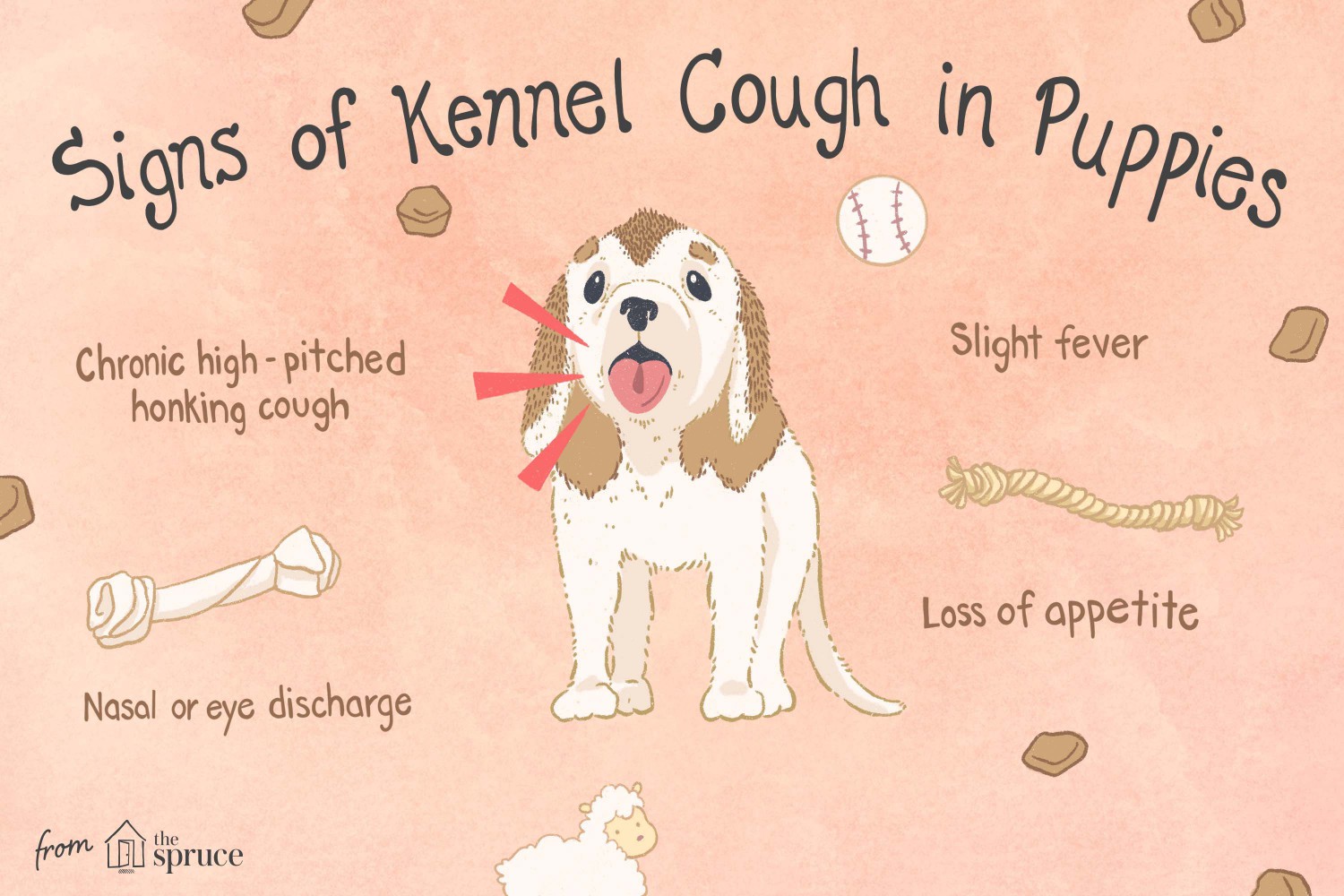
Symptoms of kennel cough usually develop between two and 10 days following exposure. Most cases of kennel cough cause mild disease, with symptoms that tend to be more aggravating to owners than dangerous to the dog.
Kennel cough causes inflammation of the trachea and bronchi, resulting in a telltale cough that often sounds like a high-pitched "goose honking." The cough can be prompted by excitement, leash tugging, drinking, or gentle pressure applied to the base of the dog’s throat. Nasal or eye discharge, fever, and loss of appetite are less common and more likely to appear if the disease progresses without treatment.
The signs of kennel cough are similar to those of other respiratory illnesses, some of which may be more dangerous, so veterinary evaluation is important. If left untreated, kennel cough can develop into life-threatening pneumonia.
The Spruce / Bailey Mariner
Kennel cough is a condition that can be caused by one or a combination of different infectious agents, including:
Kennel cough spreads through the saliva and nasal secretions. It can happen through direct contact when your dog sniffs or licks an infected dog or a contaminated object in their environment. Coughing also transmits the agents through the air from one dog to another, so nearby dogs are susceptible.
Kennel cough is most likely to spread where dogs congregate, such as boarding kennels, doggy daycare, dog shows, and dog parks.
If you suspect your dog has kennel cough, contact your veterinarian. The vet will listen to your dog's lungs and perform a full physical examination to ensure they're healthy aside from the kennel cough.
A diagnosis of kennel cough is often based on your dog's recent history and clinical signs. For instance, if your dog was recently adopted from a shelter or kennel—or spent time at a boarding facility—those are all risk factors.
In most cases, it's not important to identify the infectious agent responsible for a dog's symptoms, but tests can be run if that becomes necessary. Your vet may recommend X-rays to examine the lungs, especially if the symptoms are severe.
Kennel cough can develop into a vicious cycle. The infection causes irritation that prompts a cough, which then causes even more irritation. Mild cases may resolve at home with rest and nursing care, but if a dog's symptoms are severe or fail to improve within a few days, they'll need veterinary attention.
Antibiotics are prescribed when bacterial infections are involved. Anti-inflammatory drugs and bronchodilators (which open breathing passages) may be used to alleviate symptoms. If pneumonia develops, your dog will need more aggressive treatment, including hospitalization.
When your dog suffers from coughing or congestion, there are home remedies to soothe its symptoms during convalescence.
Refusing to eat and drink can make a dog even sicker. Ask your vet about offering pungent and more tempting foods to spark a sick pup’s appetite. Warm the food for five seconds in the microwave to just below body temperature—about 95 to 98 degrees Fahrenheit. That will unlock the aroma so the food smells more pungent and penetrates a stuffy nose.
Moisture also helps enhance the aroma. Add a small amount of warm water or chicken broth to your dog's food. Call your veterinarian if your dog's appetite doesn't improve within 24 hours.
With attentive care, dogs generally recover from kennel cough within a few weeks. Severe cases present the risk of pneumonia, which is a more serious condition and can be dangerous, requiring intensive veterinary care to avoid critical illness or death.
Because kennel cough is highly contagious to other dogs, it is important to isolate a sick or coughing dog from other canines and watch for coughing in those exposed. Infected dogs may remain contagious to other dogs for several weeks, and isolation can be challenging in multi-dog households.
A Bordetella vaccine is available to protect dogs from the bacterium that commonly causes kennel cough. These vaccinations may be given by injection or as drops in the nose or mouth; the latter stimulates what's known as a "local immunity."
Your veterinarian can advise you on the best option for your dog. Puppies typically get the Bordetella vaccine during their puppy vaccine schedule. Dogs at high risk for kennel cough may benefit from annual or biannual vaccinations. The Bordetella vaccine is often required before your dog or puppy can be boarded at a kennel, groomed, or attend training classes.
The vaccine does not prevent kennel cough caused by viruses or other bacteria. The only way to prevent these is to keep your dog away from other dogs, especially if they're coughing.
Kennel cough is highly contagious to other canines, so an infected dog should be isolated from other dogs. This is a good reason to quarantine new pets entering the home. Cats are also susceptible to Bordetella bacteria, but it's less common in cats than in dogs. And even ferrets can contract the bacteria. Although rare, Bordetella can be passed to humans and is similar to whooping cough.
Are you ready to start training your dog? A proper dog training program is the cornerstone of good behavior in dogs. It has often been said that there

There are many types of dog leashes out there, and if you're a new dog parent, you may be wondering what type of dog leash is best for you and your pu

Can dogs eat Brussels sprouts? Yes, when fed in moderation and properly prepared, Brussels sprouts can be a nutritious snack for your dog, says Kelly

Affecting dogs more than humans and other animals, hemangiosarcoma is a type of cancer that can become very serious and spread quickly throughout the
There are several pointer dog breeds, also known as bird dogs, that make great pets. If you're not familiar with the term "pointing," it d

Although there are six types of retrievers, two retrievers have ranked in the top three dog breeds in the U.S. for decades: Labrador retrievers and go
Known for their distinctive blue-tinged coats, the Texas heeler is an energetic and intelligent working breed. These dogs are a mix between an Austral

The Japanese chin, also referred to as the Japanese spaniel, is a relatively rare toy breed with a distinctly noble and ancient heritage. This dog is
We are a comprehensive and trusted information platform dedicated to delivering high-quality content across a wide range of topics, including society, technology, business, health, culture, and entertainment.
From breaking news to in-depth reports, we adhere to the principles of accuracy and diverse perspectives, helping readers find clarity and reliability in today’s fast-paced information landscape.
Our goal is to be a dependable source of knowledge for every reader—making information not only accessible but truly trustworthy. Looking ahead, we will continue to enhance our content and services, connecting the world and delivering value.